Checkout & conversion
Shopify abandoned carts vs. abandoned checkouts: find the real drop-off
Understand abandoned carts versus abandoned checkouts in Shopify. Calculate funnel drop-off correctly and choose what to fix before sending recovery emails.
The short answer
An abandoned cart is a basket that does not lead to a completed purchase within the window you are measuring. An abandoned checkout is a more specific record: the shopper entered contact information during checkout but did not finish buying. Shopify’s abandoned-checkout list therefore cannot represent every visitor who added a product and left.
A cart, a checkout event and a recovery record are different things
A shopper can put two mugs in a cart, check the total and close the tab without ever entering an email address. Another can begin checkout, provide contact details and stop at payment. Both journeys are incomplete, but the evidence available for investigating them is different.
Shopify’s abandoned-checkout documentation describes the contact-information requirement for an abandoned checkout. Do not equate a cart addition, a checkout-start event and an abandoned-checkout record. A live analytics app can observe a stage before Shopify has enough information for a recovery record.
- Cart activity
- Evidence that a shopper put products in a basket. It can reveal product interest even when no contact details are available.
- Checkout activity
- Evidence that the shopper progressed toward ordering. The event or report you use determines exactly what qualifies as reaching this stage.
- Abandoned-checkout record
- A Shopify record you can review for checkout details and available recovery actions. It is a subset of unfinished shopping journeys.
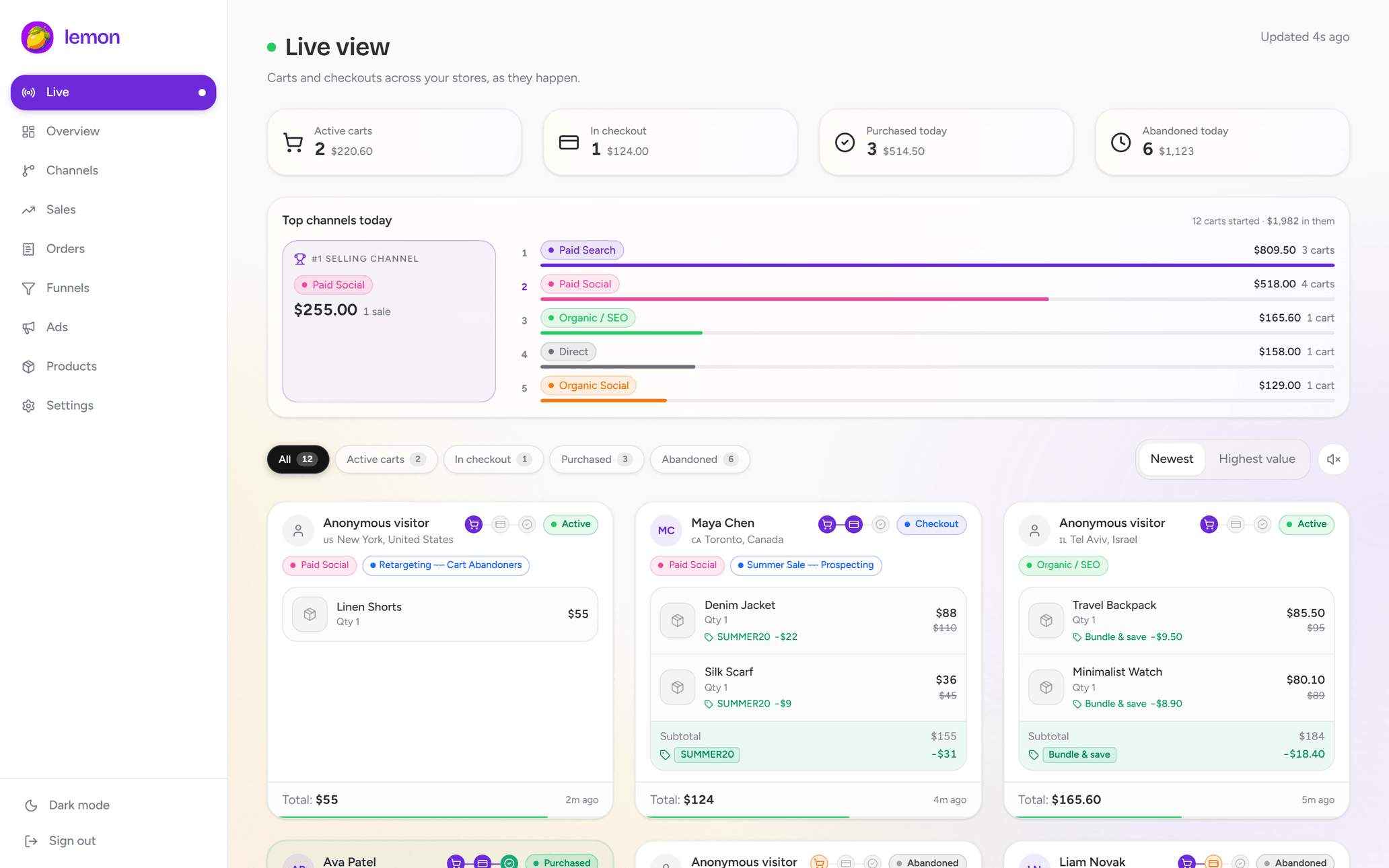
Start with the question you need to answer. To observe current shopping activity, use live cart tracking for Shopify. To investigate a failed checkout or a recovery attempt, inspect the relevant checkout record.
Measure drop-off with a consistent funnel
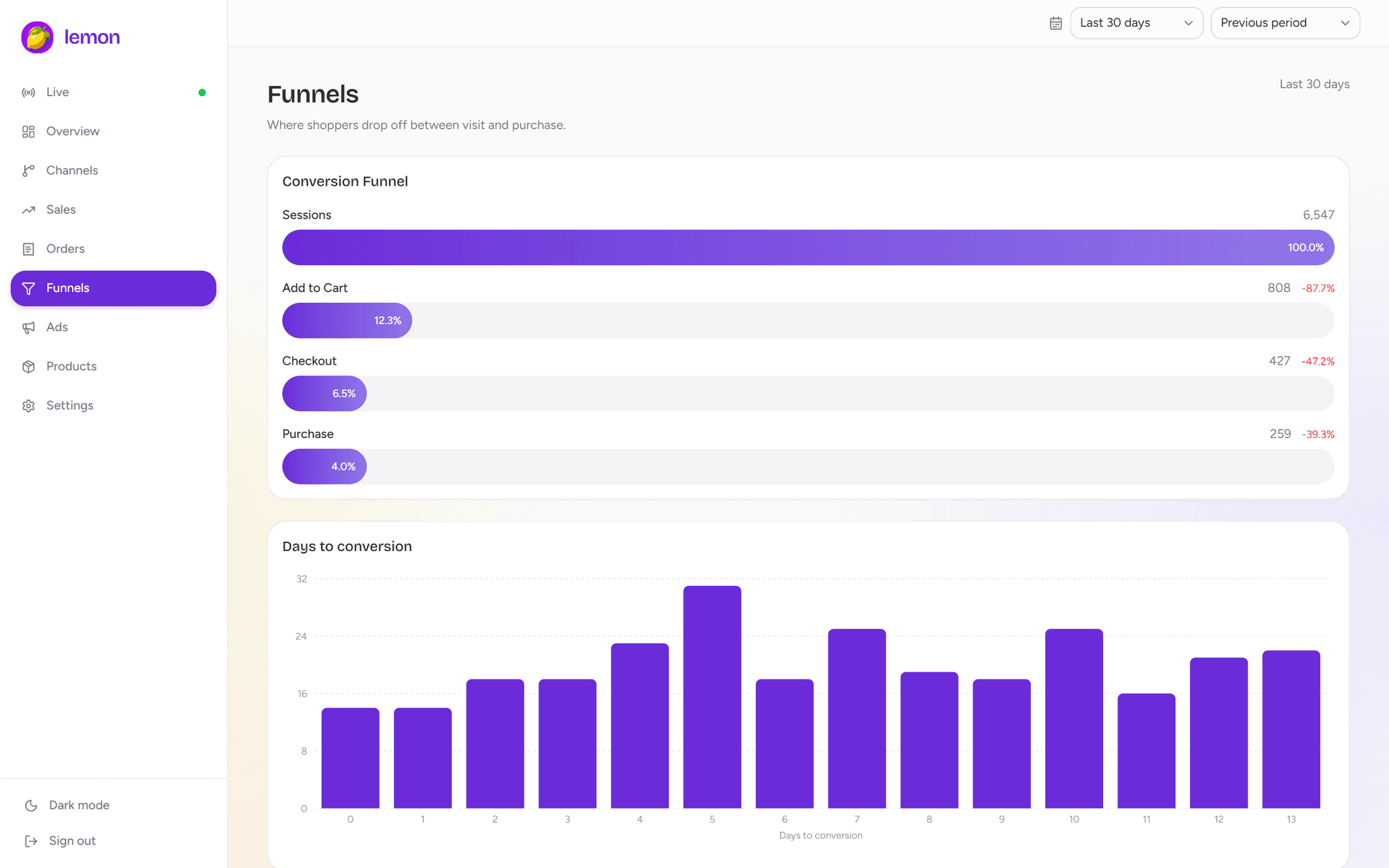
Use Analytics → Reports and find Shopify’s Conversion rate breakdown. Check its funnel setting: an open funnel can include sessions that enter partway through, while a closed funnel requires the stages in order. Shopify explains both in its behavior report definitions.
For the following illustrative example, assume one closed funnel, one store, one reporting period and one set of session filters. Every purchased session passed through both cart and checkout. These numbers are invented to demonstrate the calculation; they are not a benchmark.
Scroll across the table to see all columns.
| Stage | Sessions | Share of all sessions |
|---|---|---|
| Visited the store | 1,000 | 100% |
| Added to cart | 120 | 12% |
| Reached checkout | 72 | 7.2% |
| Completed checkout | 36 | 3.6% |
- Cart → checkout drop-off: (120 − 72) ÷ 120 = 40%.
- Checkout → purchase drop-off: (72 − 36) ÷ 72 = 50%.
- Cart → purchase drop-off: (120 − 36) ÷ 120 = 70%.
These are different questions with different denominators. The 84 cart sessions without a purchase in this example are not necessarily 84 Shopify abandoned-checkout records, nor 84 distinct people you can email.
Shopify’s stage rates use all sessions as their denominator; the stage-to-stage rates above are our calculations for this example. Keep sessions separate from orders, and do not calculate these rates from rolling live counters. Returning visits, accelerated checkout paths and the selected funnel definition can change what is counted.
If shoppers leave before checkout, inspect the basket experience
A weak cart-to-checkout transition gives you a shortlist of things to test. It does not prove which one is responsible. Reproduce the journey on the same device type and through the same landing page as the traffic you are investigating.
- Verify the offer. Does the ad promise a bundle or discount that the basket actually receives? Test the exact variants and minimum purchase requirements.
- Check the total. Can the shopper understand what is included and what shipping or tax may still change? Look for unexpected additions or unclear conditions.
- Test the next step. Is the checkout button visible and usable on a small screen? Check cart drawers, sticky overlays and quantity controls.
- Check availability. Confirm the promoted variants are purchasable and that the intended destination is served.
For example, if a mobile promotion advertises two mugs for a set price, test that exact two-mug basket. A successful purchase of a different item on a desktop does not validate the offer customers are seeing.
Use Lemon’s live cart view to find baskets worth investigating. The purpose is to narrow the test, not to infer someone’s motivation from a status label.
If shoppers leave during checkout, look for a reproducible obstacle
Open the relevant records under Orders → Abandoned checkouts and review the available details. Shopify’s documentation explains how payment events in the checkout timeline can help investigate a failed payment.
Then test the specific conditions: destination, shipping option, currency, discount and payment method. A checkout that works with one address can still fail to offer shipping for another. Keep the investigation tied to what you can reproduce.
Do not treat the absence of a payment error as proof that price caused abandonment. The shopper may simply have paused. Check patterns across comparable sessions and read any customer feedback you actually received before choosing a change.
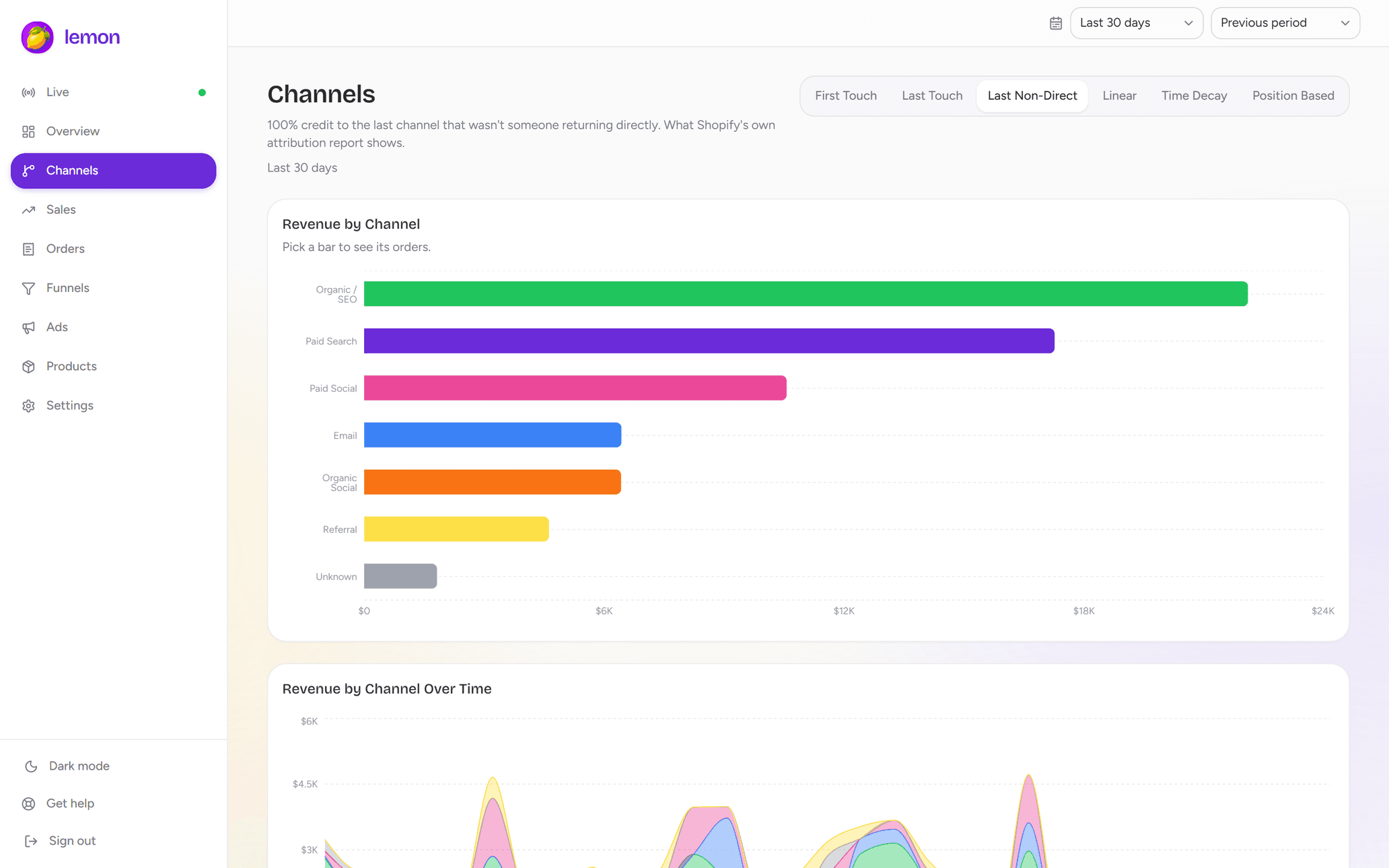
If a source produces a different mix of checkout activity, first verify its tags with our Shopify UTM and attribution workflow. Missing campaign data can make separate audiences look like one group.
Use recovery after checking that the shopper can complete the order
A reminder can invite an eligible customer back. It cannot make an unavailable shipping route available, repair a broken offer or resolve every payment problem. Check the journey before adding a discount to every recovery message.
Shopify has both legacy and newer abandoned-checkout experiences. Use its current abandoned-checkout automation guide for configuration and recipient rules rather than copying instructions from an old tutorial. Review the available recovery status before assuming an email was sent.
Lemon is an analytics app: it helps you inspect live carts, checkout stages and traffic context. It does not send recovery emails or SMS. Keep measurement and messaging responsibilities clear when choosing your tools.
Recovery reporting also needs care. If a customer returns and buys after a reminder, that sequence alone does not tell you whether they would have purchased without it. Separate the report’s attributed results from claims about additional sales caused by the message.
Run a small, disciplined weekly review
Pick one material pattern, one hypothesis and one change. Write down the reporting window, funnel setting, channel filters, device segment and number of sessions so the next comparison uses the same definition.
A useful note might read: “For mobile visitors from the autumn mug campaign, test whether the bundle condition is clear before checkout. Keep the product, campaign and audience stable while changing the explanation.” Record the outcome even if it does not support the hypothesis.
Allow enough traffic and time to compare the result meaningfully. A busier weekend or a new promotion can change the audience as well as the conversion rate. If several things changed together, describe the improvement as an observation rather than proof that one edit caused it.
Common questions
Why are there fewer abandoned checkouts than abandoned carts?
Many shoppers leave before entering contact information during checkout. A cart analytics report can also use different activity windows or status rules from Shopify’s recovery records. The two totals measure different sets of journeys.
Is every unfinished cart lost revenue?
No. A shopper may return, change the basket or never have intended to complete that purchase. Cart value measures an unfinished basket, not money the business has earned or necessarily lost.
What is a good Shopify cart abandonment rate?
There is no single target that is meaningful without the metric definition, product category, audience and reporting window. Start with your own comparable periods and separate cart-to-checkout from checkout-to-purchase drop-off.
See the journey in your own store.
Explore live carts, checkout activity and channel attribution with Lemon Analytics.